1. Why Your Website Needs to Be AI Ready: What We Learned Rebuilding Moonion From the Ground Up

Your website is no longer just a place people visit. It is a document that machines read, interpret, and quote. And most websites are not built for that.
Not long ago, a business website had one job: look good in a browser and rank reasonably well on Google. Then mobile changed things. Then voice search. Now people are typing questions into ChatGPT, Claude, Gemini, and Perplexity and getting answers without ever clicking a link. Your website is either part of that answer, or it is invisible.
We saw this shift happening and decided to stop talking about it in the abstract. We rebuilt Moonion's own website first, measured what changed, and now we are publishing what we found. This is the first in a series. Every claim in it comes from something we actually did.
The Site Now Has Three Readers, Not One

When we talk about who visits a website, most people picture a person sitting at a desk or scrolling on a phone. That picture is incomplete now. A modern website has three distinct readers: a human, a search engine crawler, and an AI system. Each one reads differently, and each one needs something slightly different from your content.
A person needs speed, clarity, and trust signals. A search engine needs structure, proper metadata, and a clean sitemap. An AI assistant needs clear, readable HTML with content that is actually in the page, not hidden behind JavaScript that executes later or locked inside a database that nothing external can see.
Most sites are optimized for one of these readers, sometimes two. Very few are built for all three at once. That gap is what we call the AI Ready problem, and it is only going to widen as more people route their information-seeking through AI systems rather than traditional search.
We use the term AI Ready to describe a site that serves all three readers well, not just humans or bots, but all three, simultaneously, from the same content.
What We Actually Did at Moonion

Before the rebuild, Moonion's website ran on Next.js with a Parse server, Apollo, GraphQL, and a separate admin interface. It was a reasonable stack for its time. It worked. But it came with real costs: infrastructure complexity, maintenance overhead, multiple moving parts that could each fail independently, and content locked behind a system that required developer involvement to change.
We moved to a static architecture where content lives in plain text files, versioned directly in the project repository. No separate database. No admin application. No GraphQL layer. The content behind our projects, partners, technology stack, team, and 15 years of key project highlights is stored in structured files that can be read by anyone and anything.
The performance numbers tell part of the story clearly. Our Lighthouse score on desktop went from 89 to 100. On mobile, it went from 59 to 100. That is not a marginal improvement. A mobile score of 59 means users on slower connections are waiting. A score of 100 means the page loads fast regardless of network conditions. Speed is not just a technical metric; it is a trust signal. It affects whether someone stays or leaves before they even read a word.
Beyond speed, we removed three infrastructure dependencies entirely. The Parse server, Apollo, and the admin application are gone. Fewer moving parts means fewer failure points, lower hosting costs, and simpler maintenance. The support burden dropped because there is simply less to support.
What AI Ready Actually Means

We want to be specific about this because the term gets used loosely. An AI Ready site is not a site where someone used ChatGPT to write the copy. That is a different thing entirely, and honestly not the point.
Here is what we mean when we say AI Ready:
- The site loads quickly on both mobile and desktop.
- It serves understandable HTML directly. Content is not hidden behind JavaScript that needs to execute before anything appears.
- Content is stored in a structured, consistent way, not scattered or formatted arbitrarily.
- It has proper titles, descriptions, canonical links, and a sitemap.
- AI systems can read the pages and any associated files cleanly, without parsing around obstructions.
- The team or client can update content without creating chaos or requiring a developer for every small change.
- AI is used to configure, develop, check, and populate the product, not to replace the people responsible for the facts and decisions.
That last point matters a lot to us. We use AI assistants in our workflow, tools like Claude Code, Codex, and others. They read the project rules, apply constraints, help fill and check content, and run automated quality checks, locally and in CI. But they work within described rules, under human control. The facts stay with the people. The expertise stays with the people. The AI helps us move faster and more accurately, but it does not replace the developer or the domain expert.
One thing we are deliberate about: we are not tied to a specific model. The model can be replaced. What stays constant is the structure of the rules and the checks. That is where the real value lives.
Why This Matters for Business, Not Just Technical Teams

The argument for an AI Ready site is not purely technical. It is a business argument.
Visibility is the first issue. If an AI assistant is answering questions about companies in your space and your site cannot be read cleanly by that system, you are not in the conversation. You are not quoted, referenced, or surfaced. That absence compounds over time as more of the discovery process moves through AI interfaces.
Content management is the second issue. When content lives in structured files in a versioned repository, updating it is fast, auditable, and does not require a developer to touch a CMS or a database. Our team can make changes that go through the same automated quality checks as code changes. Nothing falls through the cracks. Nothing breaks silently.
The third issue is cost. Infrastructure that does not exist cannot fail or require maintenance. Removing three dependencies from our stack did not just simplify things technically; it reduced real ongoing costs. For a business running multiple projects, that arithmetic matters.
What Is Coming Next in This Series

This post is the opening of a series. We built this out methodically and we are going to document it the same way.
Upcoming pieces will go deeper on each of the elements we have introduced here. We will cover why static architecture delivers speed and why it costs less to run over time. We will show how a client or non-technical team member can manage content without depending on a developer for every update. We will explain how the same content can serve a human reader, a search crawler, and an AI assistant simultaneously without duplication or compromise.
We will also get into the SEO and LLM layer specifically: how structure and metadata help AI systems not just find your content but cite it accurately. And we will look at how this approach extends to more complex product types, including online stores with product catalogs, categories, and transactional content.
Each piece will follow the same rule this one does: no promises without evidence, no architecture without real results.
The Shift Has Already Happened
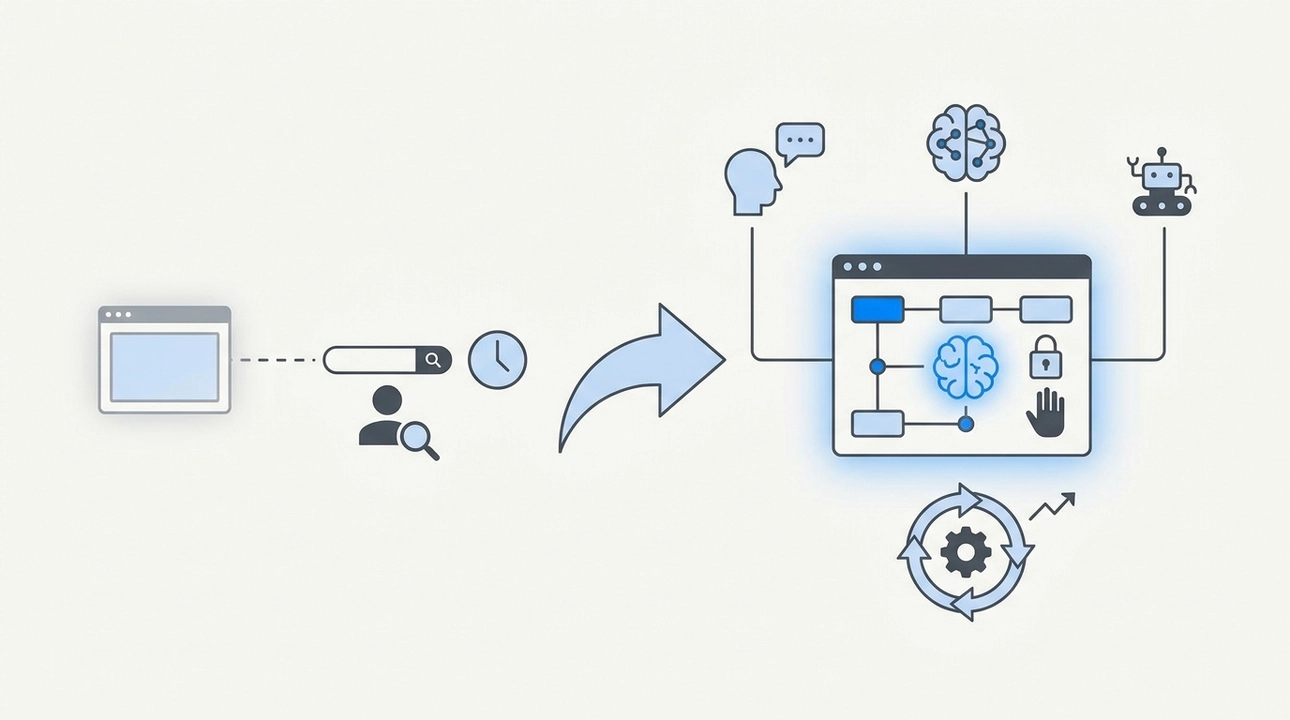
The way people find information has changed, and it changed faster than most websites were updated to reflect it. Search is no longer the only entry point. AI assistants are a primary surface now, and they read the web differently than a human or a traditional crawler does.
An AI Ready site is not a trend to chase. It is a structural investment in being legible and visible across all three of the audiences that matter right now. We know it works because we did it to our own site first, measured every part of it, and built the workflow around it from the inside.
The facts and the decisions stay with the people. The architecture just makes sure both machines and humans can find them.