8. Why AI Agents Need Rules, Skills, and Docs Before They Touch Your Project

Imagine you hire someone genuinely talented. First day, no briefing, no guidelines, no handoff. They seem confident, so you leave them to it. By the end of the week, something is broken, not because they were careless, but because nobody told them what the rules were.
That is exactly how most teams onboard AI agents. They write a prompt, get an output that looks reasonable, and move on. But one request per session is not enough to let an AI work safely inside a real project. The stakes are different when the agent has access to your content, your architecture, your live data. Without structure, even a capable AI will eventually do something you did not ask for.
At Moonion, we handle this with three distinct layers: rules, skills, and documentation. Each one does a specific job. Together, they turn an AI from a one-off assistant into a predictable, reliable part of the process.
Layer One: Rules Set the Boundaries
Rules are the general operating mode. They apply to everything the agent touches, across the whole project.

Translated out of technical language, our rules tell the agent things like: do not invent business logic; if something is unclear, ask rather than guess; cross-reference the project documentation before acting; make only the changes that were asked for, not a broader refactor that seemed useful; always run quality checks the same way a developer would; do not touch unfinished work belonging to someone else; do not close tasks or publish changes without an explicit instruction from a person.
The underlying idea is straightforward. An AI working on a real project should behave like a careful team member, not like a chat session that fires off a response and disappears. Rules enforce that behavior consistently, without relying on whoever happens to write the next prompt.
This is the part that tends to surprise clients. They assume the danger is a rogue AI doing something dramatic. In practice, the risk is quieter: an agent that fills in a gap by making a reasonable-sounding assumption, and nobody notices until the assumption turns out to be wrong. Rules close that gap before it opens.
Layer Two: Skills Give the Agent a Playbook for Each Task
If rules are the general code of conduct, skills go deeper. They are task-specific working instructions, closer to what you would put in a role description or a standard operating procedure.
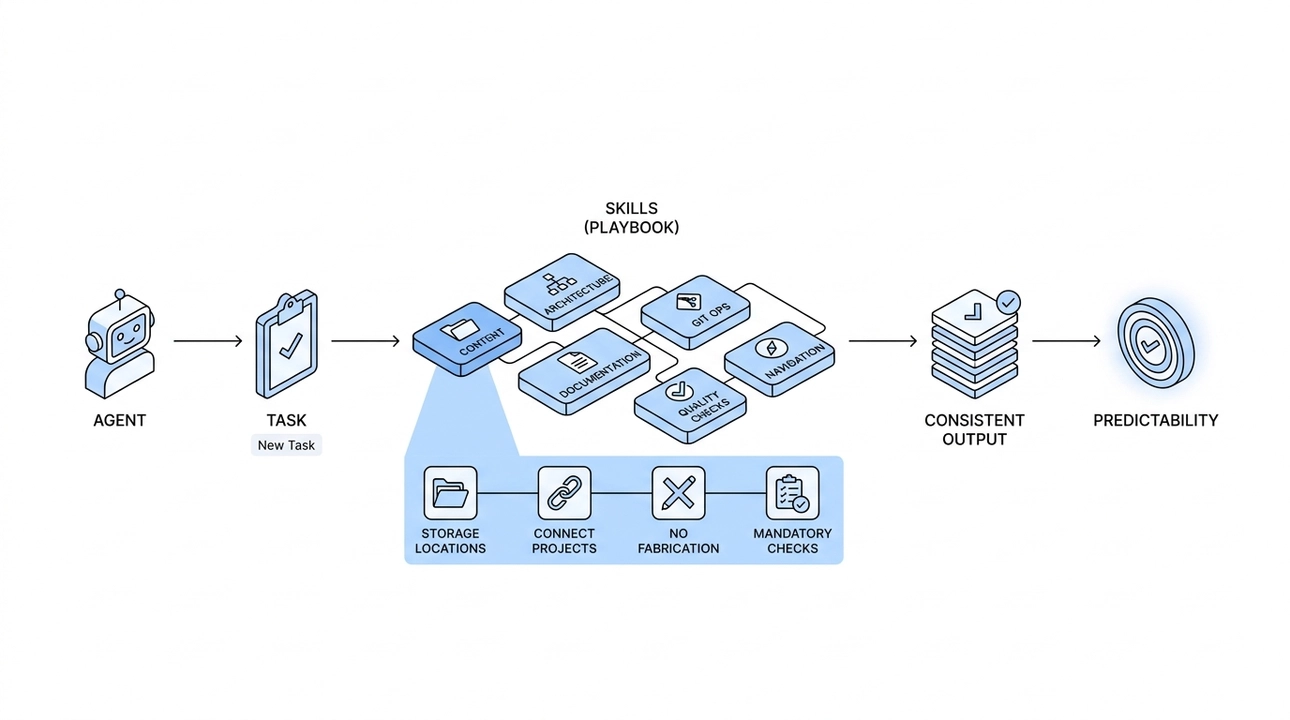
We maintain separate skills for content, architecture, documentation, Git operations, quality checks, and project navigation. When the agent picks up a task, it does not have to figure out how the project is structured from scratch. It opens the relevant skill and follows it.
A content skill, for example, explains where projects, partners, technologies, and events are stored, how to connect a project to a partner, why fabricating dates or characteristics is not acceptable, and which checks are mandatory before marking a task done. The agent is not guessing at any of that. It is reading an instruction that was written with the specific project in mind.
The practical result is repeatability. Today the agent helps add a case study. Tomorrow it updates a partner profile. The week after, it prepares product cards for an e-commerce catalog. Each task has its own skill, so the output is consistent, not a function of how well someone phrased the prompt that day.
This is what clients are really buying when they ask for AI-assisted content management. Not speed, though that follows. Predictability. The confidence that the fifth update will look as correct as the first one.
Layer Three: Documentation Is the Source of Truth
Rules tell the agent how to behave. Skills tell it how to do each task. Documentation tells it what is actually true about the project.

This is the layer that grounds everything else. Before the agent makes a change, it reads the documentation: how the architecture is structured, how content is organized, how the SEO layer works, how the LLM layer works, how everything is deployed. It acts on recorded facts, not on what seems plausible based on training data.
That matters more than it sounds. Without a documented source of truth, an AI will reconstruct its understanding of your project from context clues every single time. On a small site, the margin for error is small. On a larger product, the compounding effect of small misunderstandings becomes a real problem.
The other side of this layer is that the agent helps keep documentation current. We have a rule that any change to the architecture, content schema, or integrations must include an update to the corresponding document in the same changeset. Documentation does not drift behind the code, which is the normal failure mode on teams that grow fast.
For new people joining a project, and for AI agents picking up tasks they have not seen before, current documentation is what makes orientation fast. Instead of assembling an understanding of the system from scattered conversations and outdated wikis, they read what was recorded when the decision was made.
What This Actually Looks Like in Practice
One thing we observe constantly: when an agent works within this structure and receives new information to add to the site, it follows the skill, places the content correctly, links the relevant entities, and flags anything it cannot verify. It does not fill gaps by inventing details. The output reflects exactly what the user provided, structured the way the project expects.

Without the three layers, that same agent might produce something that reads well but contains fabricated specifics, or that quietly overwrites something it was not supposed to touch. The output looks fine. The problem surfaces later.
This is the version of AI reliability that actually matters for clients. Not "will it write a coherent sentence" but "will it do the right thing when the instruction is ambiguous, when the data is partial, when the task overlaps with someone else's work."
Why Client Hesitation Makes Sense, and What Changes It
When we describe this approach to clients, the first reaction is often some version of: "that sounds good, but I am still nervous about what the AI might break." That hesitation is reasonable. The default mental model for AI is a chat interface that generates text with no awareness of context, no memory of what it changed, and no accountability for what it gets wrong.
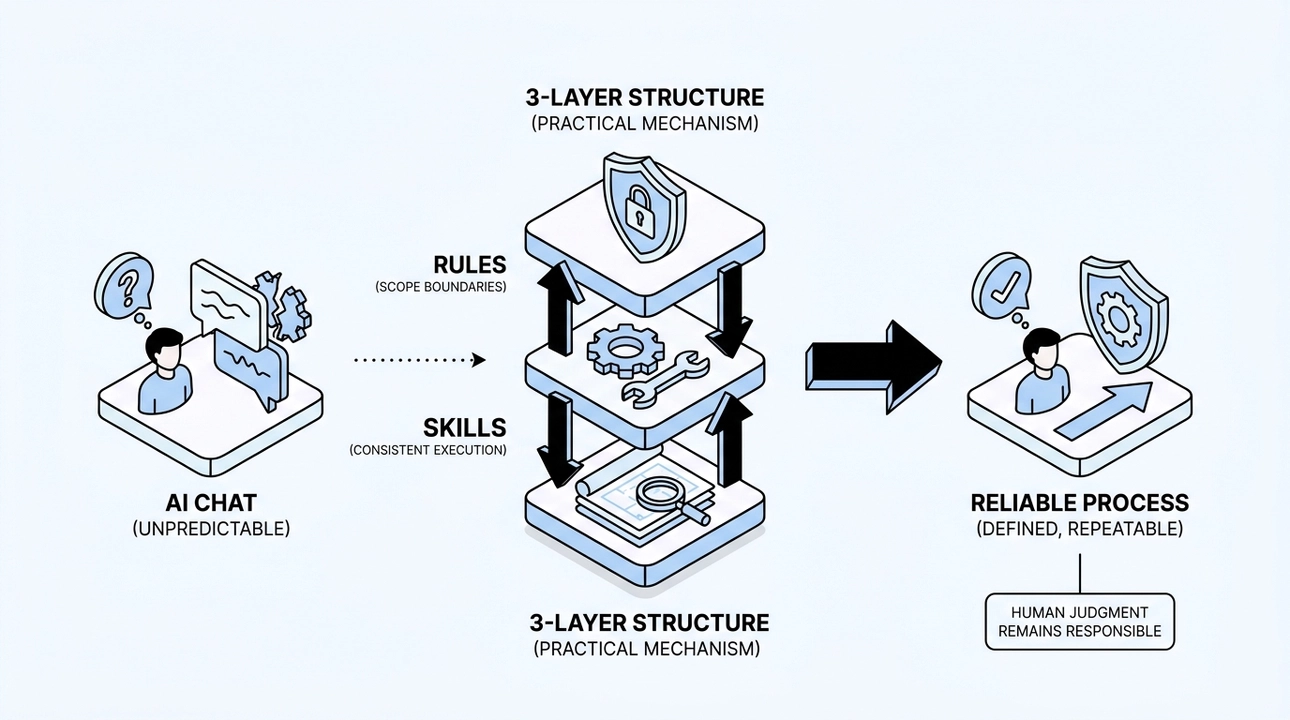
The three-layer structure is the answer to that concern, not as a marketing point but as a practical mechanism. Rules prevent the agent from acting outside its scope. Skills ensure it handles each task type the same way every time. Documentation keeps it grounded in what is actually true about the project.
Together, they shift the AI from a capable but unpredictable tool to something closer to a reliable process. The boundaries are defined in advance. The output is repeatable. Errors do not require a post-mortem to detect; they are blocked by the structure before they happen.
This is also why skills are not a replacement for human expertise. They encode a process that someone with expertise already designed. The AI executes that process consistently. The human stays responsible for the judgment calls that should not be automated.
If the analogy of a new employee holds, then rules, skills, and documentation are the onboarding that makes the hire actually work. Without them, even the most capable person will eventually step on something they did not know was fragile. With them, they can move quickly and safely from the first week.
That is what we are building toward with AI-ready sites: not a system where AI does whatever seems right, but one where it knows exactly what right means for this specific project, and operates accordingly.