2. What an AI Ready Product Actually Is (And What It Definitely Is Not)

There is a lot of noise around AI right now. Every product team is adding something, shipping something, calling something AI-powered. And in the middle of all that noise, it gets very easy to confuse activity with discipline. So before we get into what an AI Ready Product is, let us be clear about what it is not.
It is not a product where someone dropped a ChatGPT chat widget onto a page. It is not a site where all the copy was generated by a model and called done. It is not a promise that AI now handles everything while humans step back and watch. Those things are easy to build. They are also easy to break, hard to maintain, and nearly impossible to trust at scale.
An AI Ready Product is about discipline, not magic. That distinction matters more than most teams realize until something quietly goes wrong.
What "AI Ready" Actually Means
The core idea is straightforward: a product designed so that AI can safely assist in development, configuration, content management, and optimization, while humans remain responsible for facts and decisions. That last part is not a disclaimer. It is the architecture.
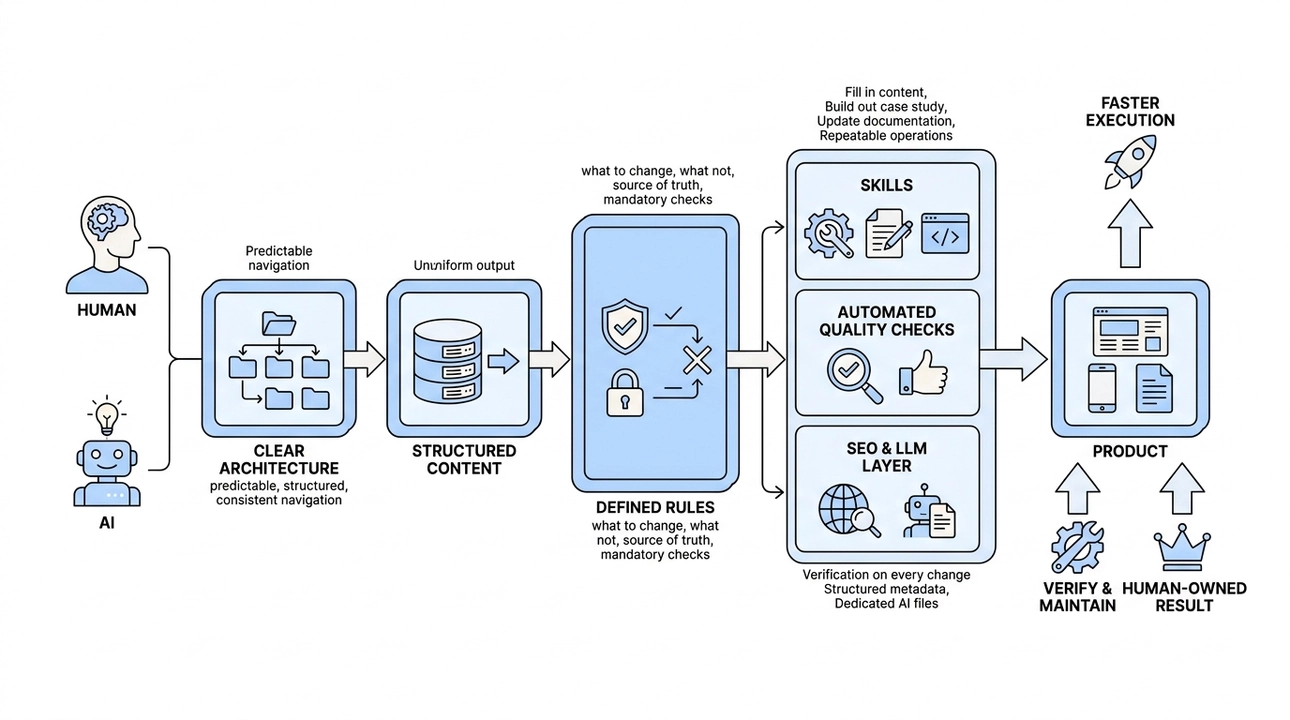
When we talk about AI Ready, we mean a product where the structure itself enforces quality. Where AI is not a shortcut around good process, but a tool that operates within it.
There are several layers to how that works in practice.
The first is clear architecture. The file structure is predictable and consistent, something both a developer and an AI agent can navigate without guessing. When structure is ambiguous, AI makes assumptions. Assumptions compound. Clear architecture removes that risk at the foundation.
The second is structured content. Data lives in a consistent format, not scattered across different systems in different shapes. When content is structured, it is much harder to accidentally break. When it is not, even a small AI-assisted edit can quietly corrupt something three layers deep.
The third is defined rules for AI agents. This is where most products stop short. They give AI access but no boundaries: what it can change, what it cannot, where the source of truth lives, which checks are mandatory before anything ships. Without these rules, AI is just a fast way to make confident mistakes.
Beyond those three, there are skills, which are essentially instructions scoped to common tasks. Fill in content. Build out a case study. Update documentation. These are repeatable, low-ambiguity operations that AI handles well when it has a clear playbook. There are also automated quality checks, the same verification a developer would run, triggered on every single change. And there is the SEO and LLM layer: metadata structured for traditional search alongside dedicated files formatted for AI systems to read cleanly.
The process that ties it all together is simple: humans own the facts, AI helps execute, format, verify, and maintain the result faster than any team could do alone.
One more thing worth saying: none of this is locked to a specific model. Claude, Codex, or whatever comes next, they are interchangeable within this system. The layers hold quality regardless of which tool you are using today. That is intentional. Model dependency is its own kind of technical debt.
How We Built This at Moonion
When we rebuilt Moonion's site, we did not just migrate pages from the old version. We rethought what the product needed to be in order to work reliably with AI assistance over time.
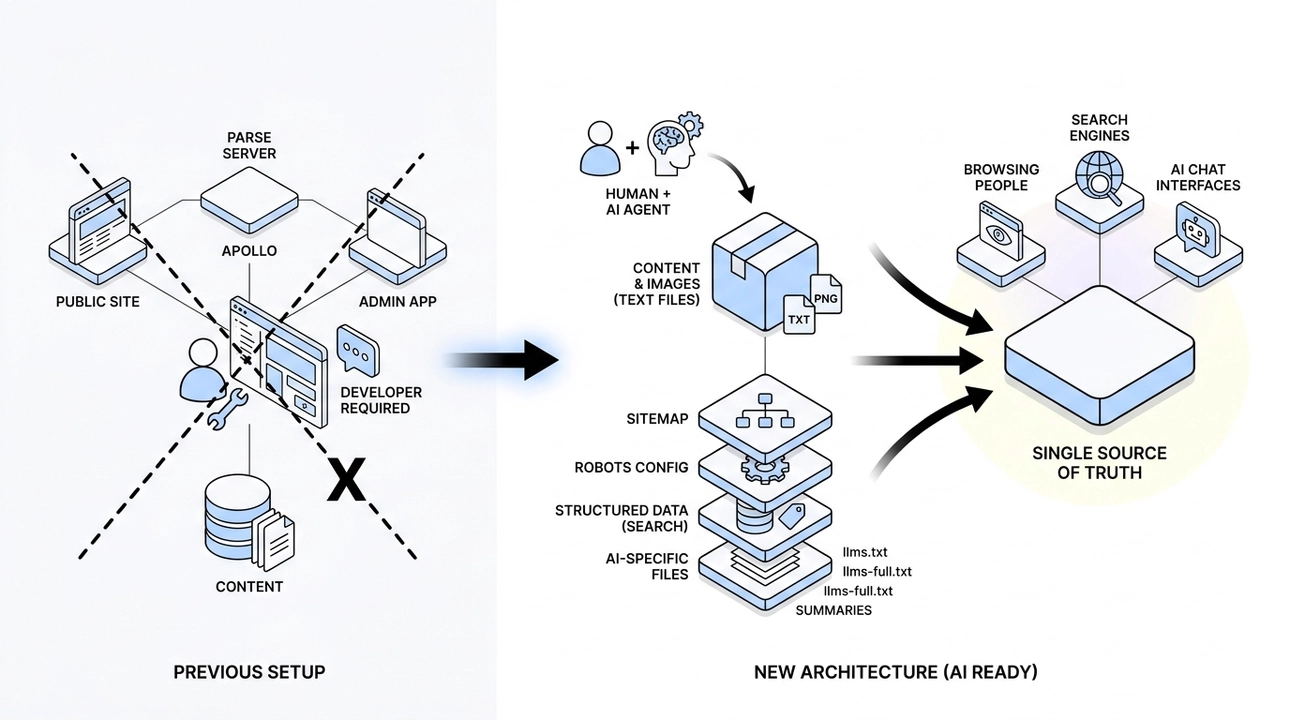
The previous setup had the public site dependent on Parse Server, Apollo, and a separate admin application. Editing content required a developer, or at minimum, someone navigating a custom admin interface. That is a fragile chain. We removed it.
Instead, all content moved into simple text files. Images sit alongside them in the repository. No separate content management layer, no runtime dependencies between content and the tools used to edit it. The combination of a human and an AI agent now handles what the admin application used to handle, with more consistency and fewer moving parts.
On top of that structure, we added the layers that make it AI Ready: a sitemap, robots configuration, structured data for search, and public-facing files built specifically for AI systems. That includes llms.txt, llms-full.txt, and individual summary files for each project and partner.
What that means in practice is that an AI assistant can read the project rules, understand the structure, edit content without inventing facts, and run through the same automated checks a developer would. The same material serves people browsing the site, traditional search engines, and AI-powered chat interfaces, all from a single source of truth.
That last sentence is worth pausing on. In most products, these are three separate concerns managed in three separate ways. In an AI Ready Product, they converge. One well-structured source, readable by everyone and everything that needs it.
What This Gives a Business
The business case for an AI Ready Product is not about moving faster, though you do move faster. It is about predictability.
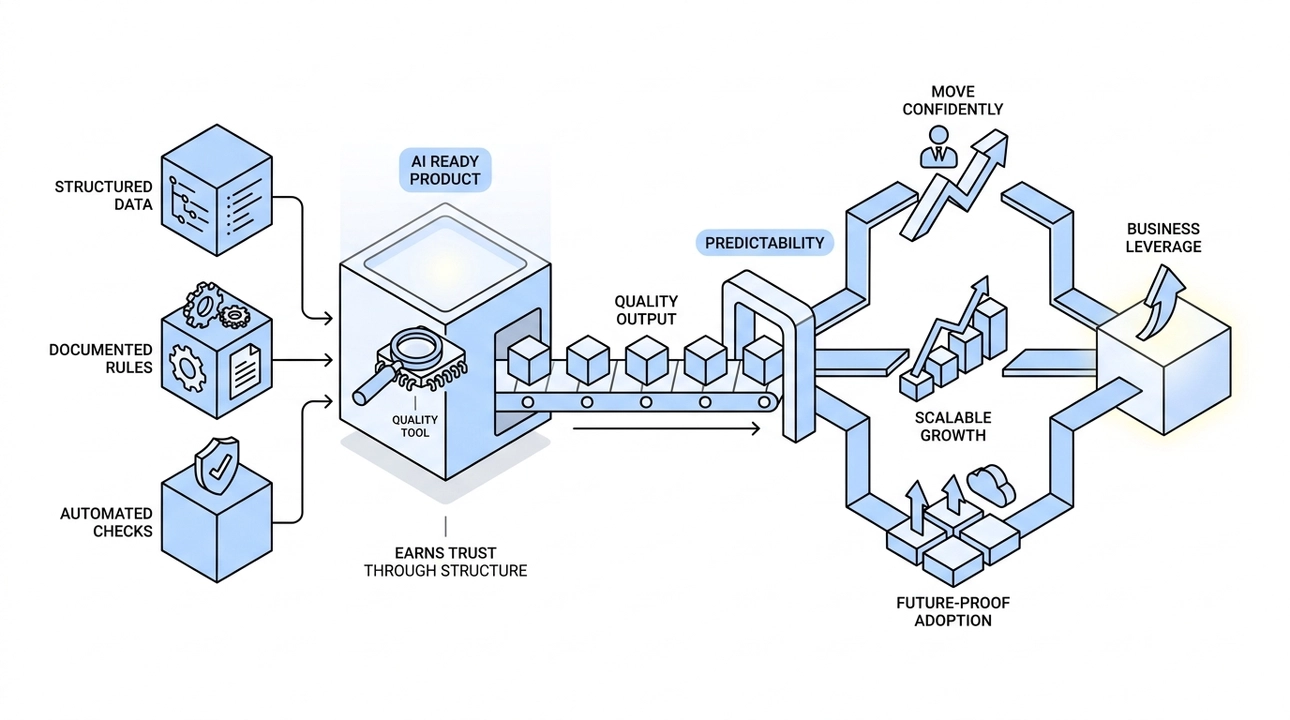
When data is structured, rules are documented, and checks run automatically, you know what you are shipping. AI becomes a quality tool operating inside a defined process, not a generator producing output you then have to manually audit for accuracy. That difference changes the economics of the whole operation.
Teams can update content, build out new cases, and iterate on documentation without worrying that an AI-assisted change will silently break something downstream. The architecture makes that category of error structurally hard to make.
For a business, predictability is leverage. It means you can move confidently, not just quickly. It means the product can grow without the maintenance cost growing at the same rate. And it means that when better AI tools arrive, you can adopt them without rebuilding the foundation they run on.
That is the point of AI Ready. Not to hand control to AI, but to design a system where AI earns trust through structure, not through promises.
We are still building toward that standard ourselves. But every layer we add makes the next one faster to get right. That compounding effect is what discipline actually looks like in a product.