13. SEO Is Not Dead in the Age of AI Search. It's More Important Than Ever.

There is a myth spreading fast right now, and we hear it constantly from founders and builders: now that people ask ChatGPT their questions and read AI-generated answers inside Google, classic SEO no longer matters. The logic sounds almost reasonable. If the AI is writing the answer, why does it matter whether your page ranks?
The logic is wrong. AI search does not replace the need for solid SEO. It amplifies it, and the reason is arithmetic. A page of search results has room for ten links and everything below the fold. An AI answer cites a handful of sources, sometimes one. Changing the interface does not remove the competition for visibility, it narrows it. Ranking on the first page used to be the goal. It is now closer to the entry requirement for being eligible to appear in the answer at all.
Why AI Search Runs on the Same Rails as Traditional Search
AI systems do not pull information from thin air. They depend on the same web infrastructure that traditional search relies on: crawlable pages, clear structure, reliable content, and machine-readable signals. If your page is difficult to crawl, if its content is buried behind broken code, or if it sends no clear signals about what it actually is, then it is invisible to Google, to Bing, and to the AI systems drawing from those indexes.
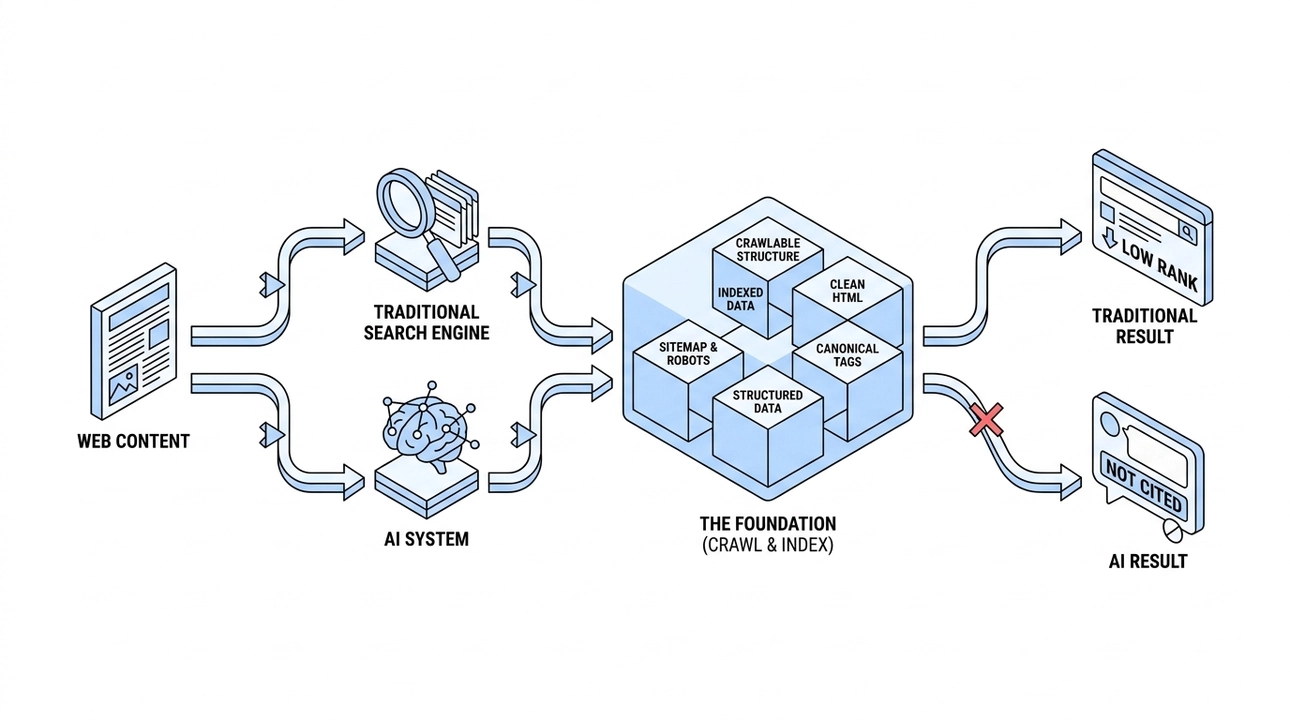
The underlying problem is the same. Only the consequences are slightly different. With traditional search, poor structure can hurt rankings. With AI search, it can also reduce the chances that your content is understood, retrieved, and cited accurately.
The foundation has not changed. Pages need to be easily crawlable. They need to be properly indexed. Titles, descriptions, canonical tags, sitemaps, and clean HTML need to be in order. These are not optional refinements for when you have spare time. They are the minimum requirement for existing on the modern web.
When we rebuilt Moonion’s website, this was part of the migration plan from the beginning: preserve existing URLs, configure redirects properly, remove the outdated keywords meta tag that search engines stopped reading years ago, add canonical links, social preview data, structured data, a sitemap, a robots file, and a clean 404 page. Each of those decisions was deliberate, not decorative.
Metadata Is a Language, Not a Decoration
The shift in thinking that matters most here is treating metadata as a communication layer, not a formatting task. Metadata is not just about how a page looks in search results or social previews. Together with structured data, canonical signals, headings, and the content itself, it helps machines understand what a page represents and how it relates to the rest of the site.
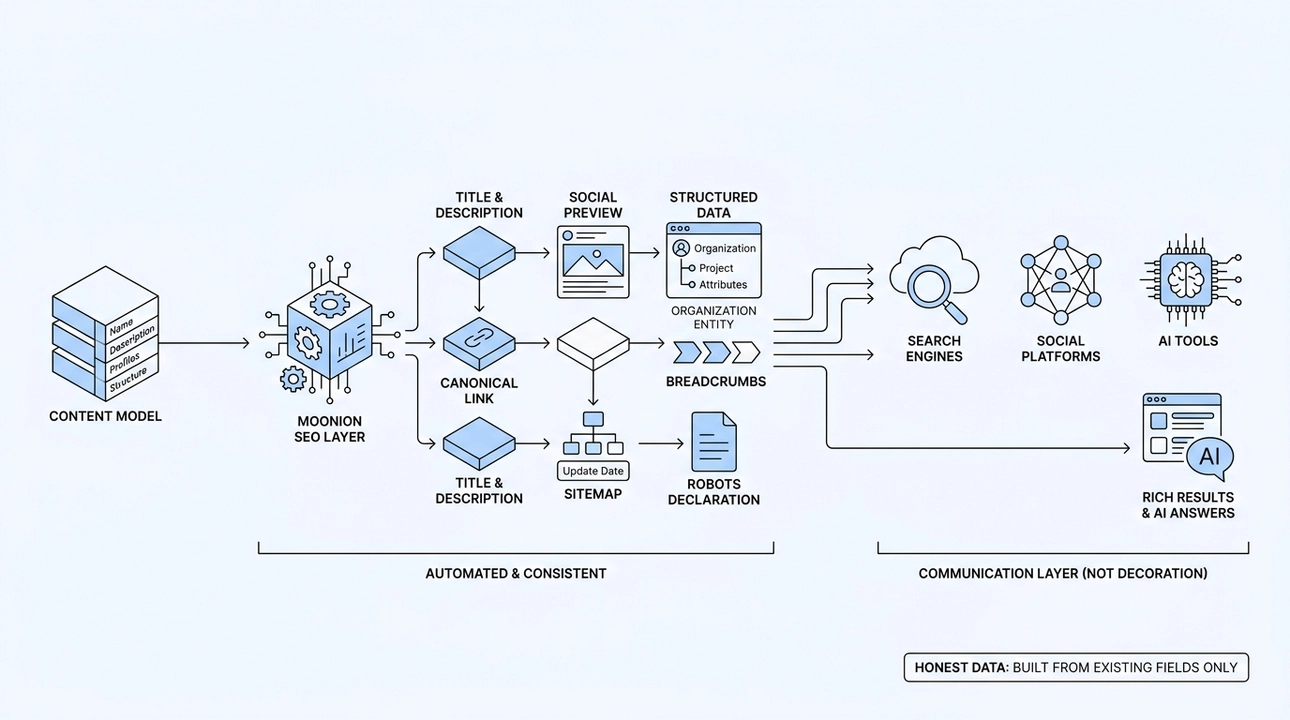
The difference is between saying "here is some text, figure it out" and saying "this is an organization, here is its name, here are its profiles, this is a project, here is its description, here is where it sits in the structure of the site." That specificity is what structured data provides.
On Moonion’s website, the SEO layer generates this automatically on every page. Each page gets a predictable title and description, a canonical link, social preview data with an image for clean previews in messengers and social platforms, structured data that describes the entity on the page, breadcrumbs, a sitemap entry with an accurate last-modified date, and the correct robots directives. None of this is assembled by hand for each page. It is derived from the same content model that builds the pages themselves.
That matters because consistency is what makes it trustworthy. If structured data is generated manually, it drifts. Fields get forgotten, descriptions go stale, breadcrumbs break after a site restructure. When the data is generated from the model, updating the content updates the metadata automatically.
One principle runs through all of this, the same one that runs through the entire AI Ready series: structured data is built only from fields that actually exist. If a project has no description, the system does not invent one. If a piece of content has not been verified, it does not get added. Metadata describes the object honestly. It does not manufacture one.
This matters especially for e-commerce. Structured data can describe a product, its category, its price, availability, shipping, return policy, and reviews. That is exactly the kind of machine-readable information search engines can use for rich results, and that AI systems can use to better understand the product and its attributes. But only if the data is real and verified. If it does not match what is actually on the page, search engines may ignore the markup, remove rich-result eligibility, or treat the data as unreliable. There is no shortcut here.
Multilingual Sites, Accessibility, and the Signals You Cannot Afford to Skip
Two areas tend to get deferred, and both carry real consequences.
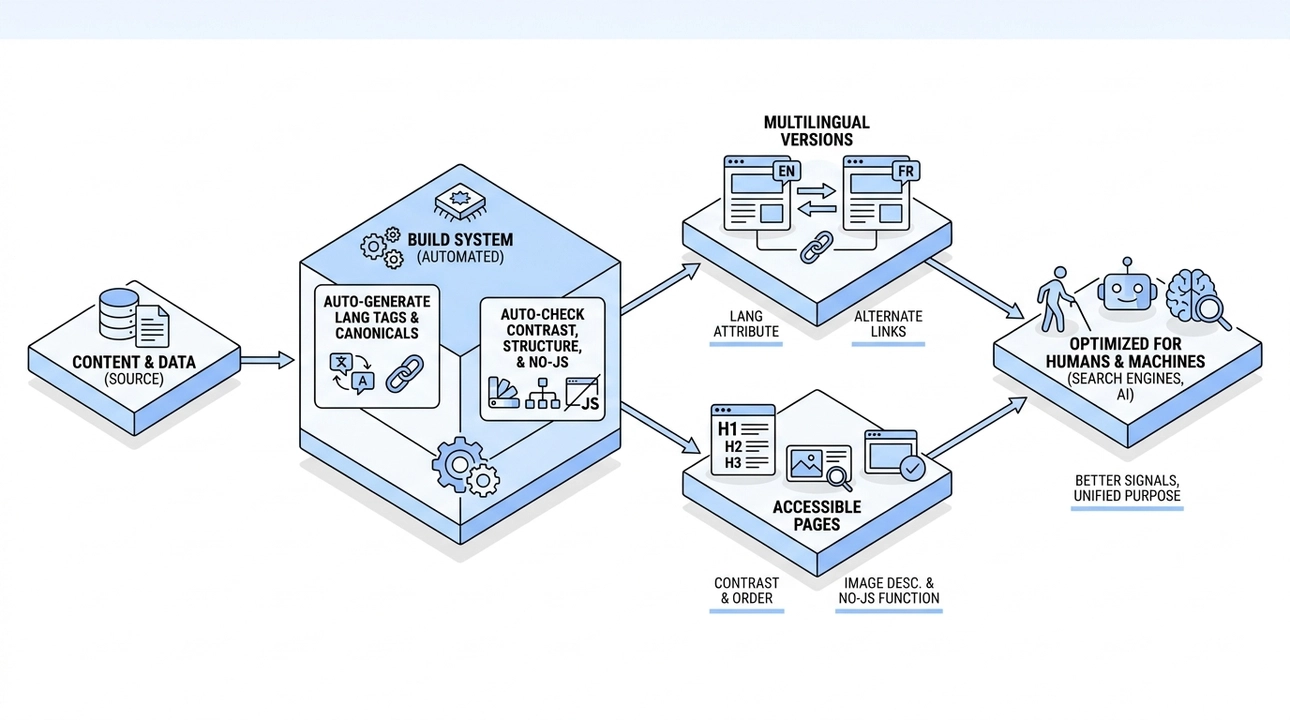
The first is multilingual handling. When a site has multiple language versions, each page needs to declare its own language and list its equivalents in other languages. Without those signals, search engines have less information about which language or regional version should be shown to a particular user. Language versions are not an afterthought. They need to be part of the content model.
The principle here is the same one that governs the rest of the metadata: whatever describes a page should be derived from the content model, not maintained alongside it. Canonical addresses and sitemap entries on our own site already work exactly that way. When a project needs language versions, they belong in that same model, so that adding a translation declares it correctly by construction instead of adding one more manual step somebody has to remember.
The second area is accessibility. Text contrast, heading order, image descriptions, and page functionality without JavaScript are typically framed as requirements for users with visual impairments. They are. But a crawler or an AI system reading that page has to work with the same properties: a sane heading order, real text instead of text baked into an image, a page that means something before the scripts run.
A page that depends entirely on scripts, has a confusing heading structure, or provides no textual context for important images creates unnecessary barriers to understanding for people, crawlers, and other machines.
We run automated checks for contrast in both light and dark themes and for structural integrity at build time. Not because accessibility is a nice-to-have. Accessibility and machine readability are not the same thing, but they often reward the same engineering discipline: semantic HTML, meaningful headings, descriptive text, predictable structure, and content that does not depend entirely on client-side behavior.
What This Actually Looks Like in Practice
A week after launching the rebuilt Moonion website, before indexation had even completed, project pages were already surfacing on the first pages of results for their own queries, such as "wahgo" and "enchant ticketing". Taken alone that is a modest result: a site ought to rank for the names of the things it built. What made it worth noting was the speed. New URLs, a new structure, no accumulated authority on any of them, and the pages were still discovered, parsed, and indexed within days. That is what a clean technical foundation actually buys: no lag between publishing something and having it understood.
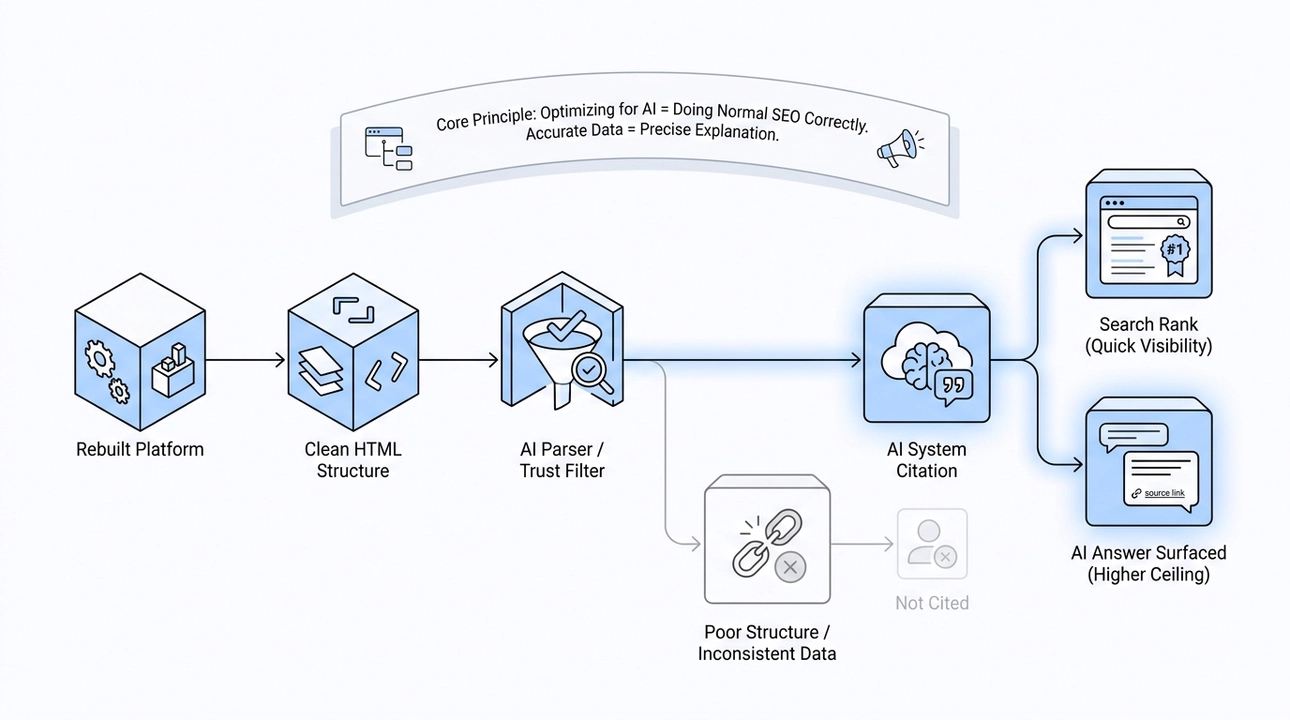
The path to visibility in AI-generated answers runs through exactly that foundation. AI systems are more likely to use sources they can reliably read, parse, and understand. Clean HTML, accurate structured data, correct canonicalization, and verified content make that job easier.
There is no credible AI search strategy that bypasses these fundamentals. There is just the work of making your site technically legible, which has always been what good SEO required. The stakes are higher now because the ceiling is higher: a well-structured page does not just rank, it gets surfaced inside AI answers to the specific questions your customers are asking.
For a business this is not a technical line item. Structured data is an extension of your content model, which means the accuracy of your metadata is capped by the accuracy of what you have actually written down about yourself. Get that part right and the same work pays three times over: in search results, in link previews, and in what an AI assistant says to someone who asked about your industry rather than about you. Everything covered here is the floor. The layer that sits on top of it, built specifically for AI systems to read, is the subject of the next article in this series.