6. One Content Source for Humans, Search Engines, and AI Chats: Is That Actually Possible?

Your website has three readers now. Not one.
A person opens a page and takes in the text, the images, the layout. A search engine scans the headings, the meta description, the structured data, the sitemap. An AI chatbot like ChatGPT or Claude pulls the content to summarize who you are and what you do, often in a single paragraph, before a user even clicks through to your site.
Three readers, three very different ways of consuming what you publish. And in most setups, businesses have responded to this by managing content in three different places. There is the text on the page. Then there is the SEO layer: the title tag, the meta description, the canonical URL. Then there is whatever summary or briefing document someone put together for AI systems to reference. Three separate things to write, update, and keep in sync.
That is where the problem starts.
Why Does Managing Content in Three Places Break Down?

It breaks down because updates do not travel automatically. You refresh your service description on the page, but the meta description still reflects last year's positioning. You change your project list, but the summary document you once prepared for AI systems still references a project you dropped six months ago.
Over time, the three versions drift. The human visiting your site sees one story. The search engine reads a slightly different one. The AI chatbot tells its user something that is outdated, or inconsistent with what you actually do today.
This is not a hypothetical failure mode. It is what happens in practice when content is distributed across separate locations without a single source of truth. And the consequence is more serious than it might sound. When a potential client asks an AI chatbot about your company and gets a stale or contradictory answer, that is a trust problem, not a technical footnote.
What Does a Single Source of Content Actually Look Like?
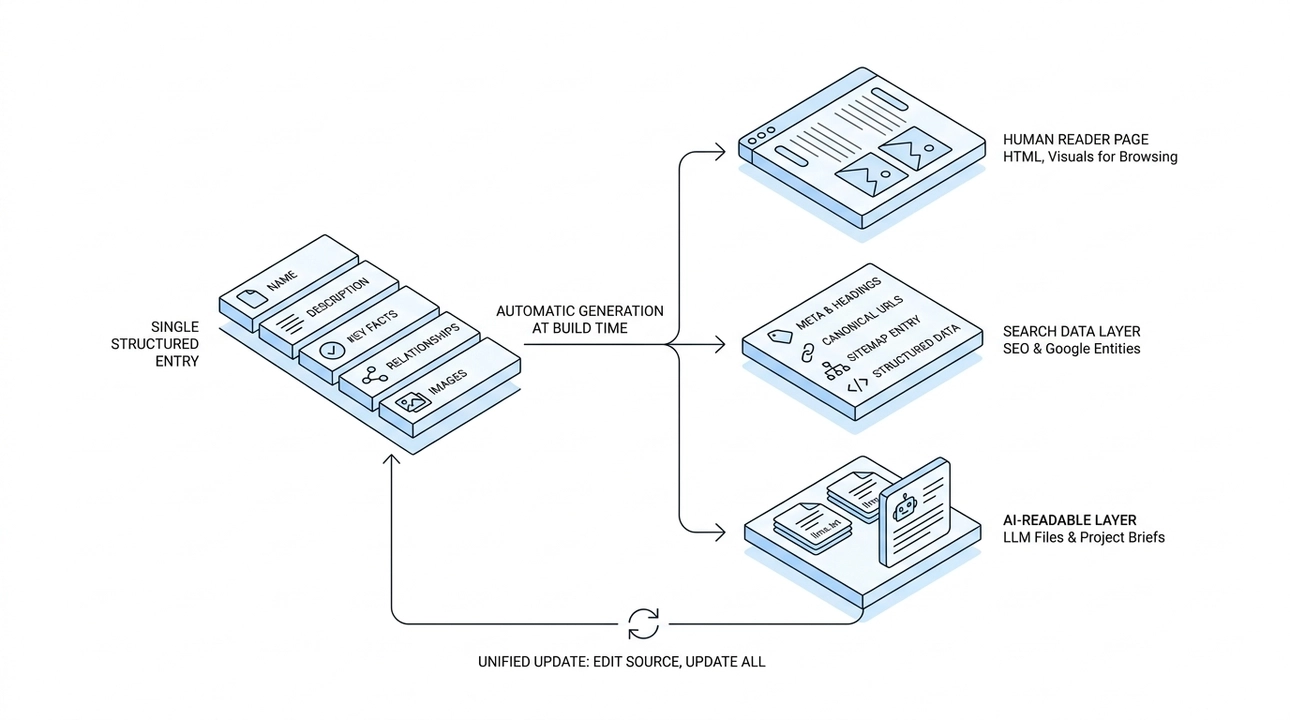
The AI-ready approach we use at Moonion is built around exactly this idea: one record, three representations.
For every project or service, there is a single structured entry. It contains the name, the description, the key facts, the relationships to other entities, the images. That is the source. Everything else is generated from it automatically at build time.
From that one record, three things are assembled without any manual duplication:
- The page for the human reader, standard HTML with text and visuals laid out for browsing.
- The search data layer, including headings, meta descriptions, canonical URLs, sitemap entries, and structured data that tells Google what kind of entity this is.
- The AI-readable layer, which on our site takes the form of llms.txt and llms_full.txt files, plus individual card-style briefs for each project, formatted so that AI systems can read and reference them cleanly.
You edit one source. All three representations update together. There is nothing to duplicate, and nothing to forget.
Why Does Structured Data Matter for Search Engines and AI Alike?

Structured data is the part of this that often gets treated as an afterthought, but it is doing real work. When we include structured data in the search layer, we are not just providing text for Google to index. We are telling Google what the content is: this is a project, this is a company, this is a technology. That kind of explicit labeling helps search engines surface the right result for the right query, rather than guessing from context.
What is interesting is that this same precision matters for AI systems too. AI chatbots increasingly rely on well-organized, clearly labeled content to produce accurate summaries. Vague or unstructured content produces vague or wrong answers. Structured content, with named fields and explicit relationships, gives AI systems the clarity they need to represent you accurately.
The principle behind both use cases is the same: clarity of source produces quality of output.
What Happens When There Is No Data to Fill a Field?

One thing worth being explicit about: the AI-readable files we generate do not invent content. If a project entry is missing a description, that block is simply omitted from the output. It does not get filled with a placeholder or a guess.
This is a deliberate design choice, and it matters. The consistency we are aiming for only has value if the content is accurate. An AI chatbot that summarizes your company based on fabricated or padded entries is not better than one working from outdated data. It might actually be worse.
The rule we follow is that the AI layer reflects exactly what is in the source, no more and no less. Which means the quality of what AI systems say about you is a direct function of the quality of what you have actually written. This is one reason why investing in clear, factual, well-structured content is not just an SEO exercise. It is an investment in how your business is represented everywhere.
Does This Approach Actually Work in Practice?
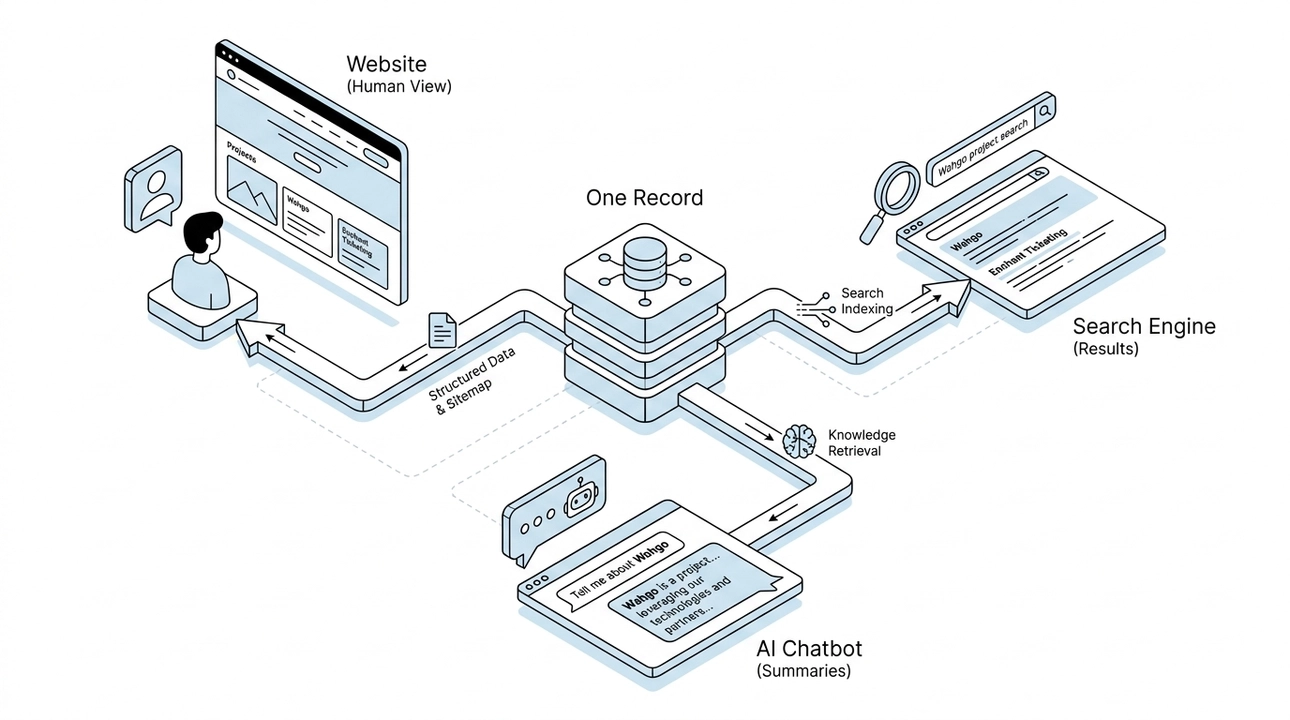
We did not pitch this to clients before we tested it on ourselves. Our own site runs on this architecture, and the consistency is visible from both sides.
For project-specific queries, like searches for Wahgo or Enchant Ticketing, the work shows up in search results because the structured data and sitemap entries are generated correctly from the source records. For broader questions about our company, AI chatbots return summaries that reference the same facts, projects, partners, and technologies that appear on our site, because they are drawing from the same source.
One record. And the human, the search engine, and the AI chat all receive a coherent version of the same story.
What Does This Mean for Your Business Day to Day?
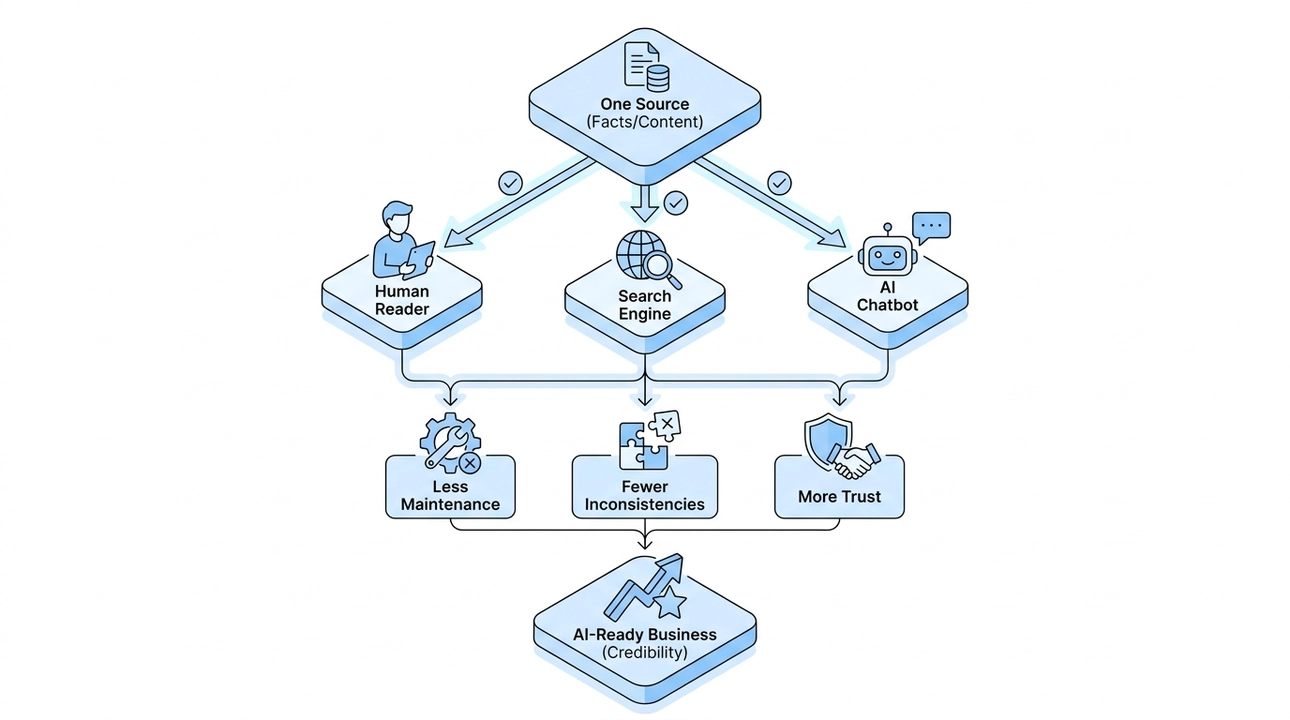
The practical benefit is simpler than it might sound. You maintain facts in one place, and those facts work consistently across all three audiences. You do not have a separate SEO task on your plate every time you update a project description. You do not need to remember to update a briefing document for AI systems. You make one edit, and it propagates.
That means less routine maintenance, fewer inconsistencies between what your site says and what an AI chatbot says about you, and more trust from everyone who encounters your business, regardless of how they find it.
There is a subtle but important point here about trust specifically. When a human reads your site, a search engine indexes it, and an AI chatbot summarizes it, and all three reflect the same honest facts, that alignment itself signals credibility. There is no version drift to catch you out. No outdated summary contradicting your current positioning. Just one consistent, accurate story told three different ways.
That is what it means to be AI-ready in terms of content. Not a special file you maintain separately. Not an AI optimization layer bolted on after the fact. One source, built right, that serves everyone who reads it.