14. llms.txt and the AI Layer Your Site Is Missing: How to Get Represented Accurately in AI Chat

The first time many people encounter your company today, it is not on your website. They type a question into ChatGPT, Claude, or Gemini, and they get an answer. Whether that answer accurately describes you, your projects, your team, and what you actually build, that part is largely up to you.
Most businesses have not thought about this yet. They assume that having a good website is enough, that AI systems will figure it out. Sometimes they do. More often, they approximate, stitch together fragments, or fill gaps with confident-sounding guesses. That is not a content problem. That is an architecture problem, and it has a practical solution.
At Moonion, we have built a dedicated layer on our site specifically for AI systems to read. The results were noticeable within a week of going live, well before full indexing. Here is exactly how we built it and why the design decisions matter.
What llms.txt and llms-full.txt Actually Are
The idea behind llms.txt is simple: instead of making an AI system parse a fully rendered web page complete with navigation menus, buttons, styling, and promotional copy, you give it a clean, structured text file that contains the essential facts about your site.
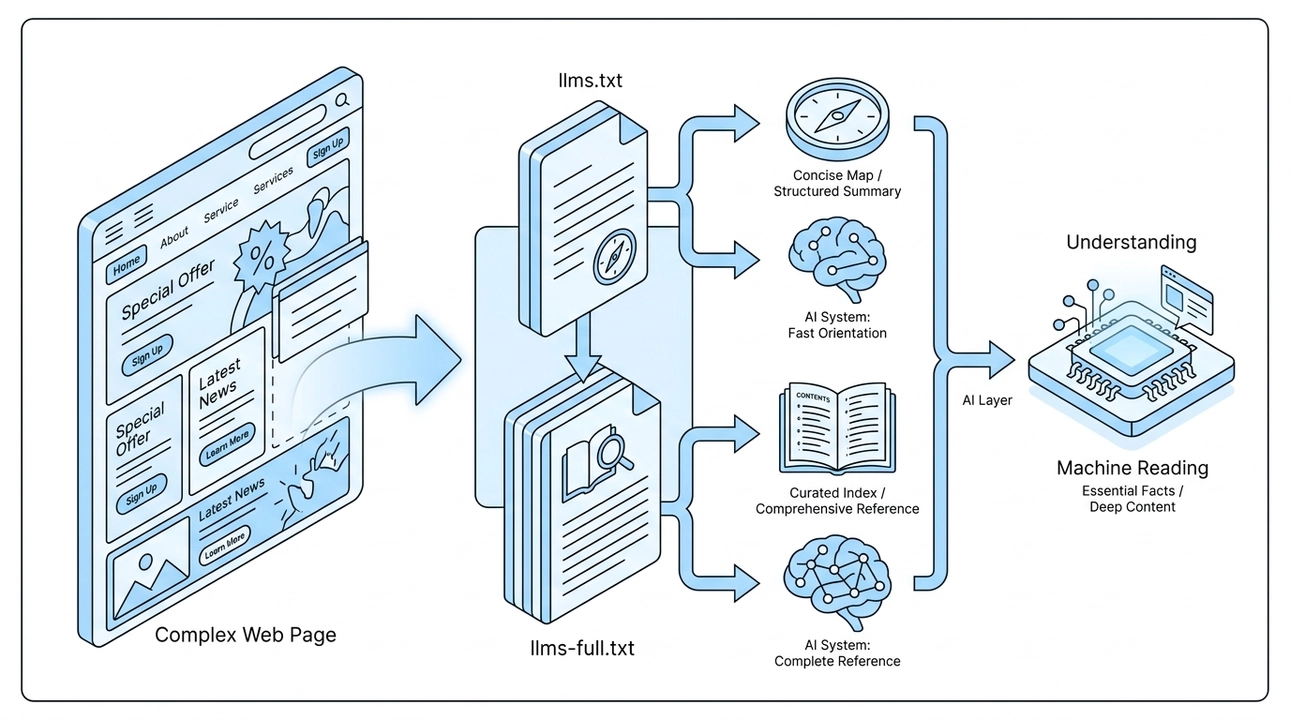
Think of it as a concise entry point. A clear map. When an AI system wants to understand who Moonion is, what we build, and who we work with, it can go directly to llms.txt and get a structured summary without having to reverse-engineer the design of a webpage.
llms-full.txt goes deeper. It is a comprehensive index of everything published on the site: all projects, all partners, each one with a direct link and a brief description. It is not a sitemap in the traditional sense. It is more like a curated table of contents written for machine readers, where every entry is meaningful and nothing is filler.
Together, these two files form what we call the AI layer of the site. One file for fast orientation, one for complete reference.
How We Structure the Project Briefs
The real substance lives in the individual entity briefs referenced from llms-full.txt. For each project or partner, a brief can include the main page URL, a description, the case study text, related partners, categories, technologies, team members, key events, and the text content from each section of that page.
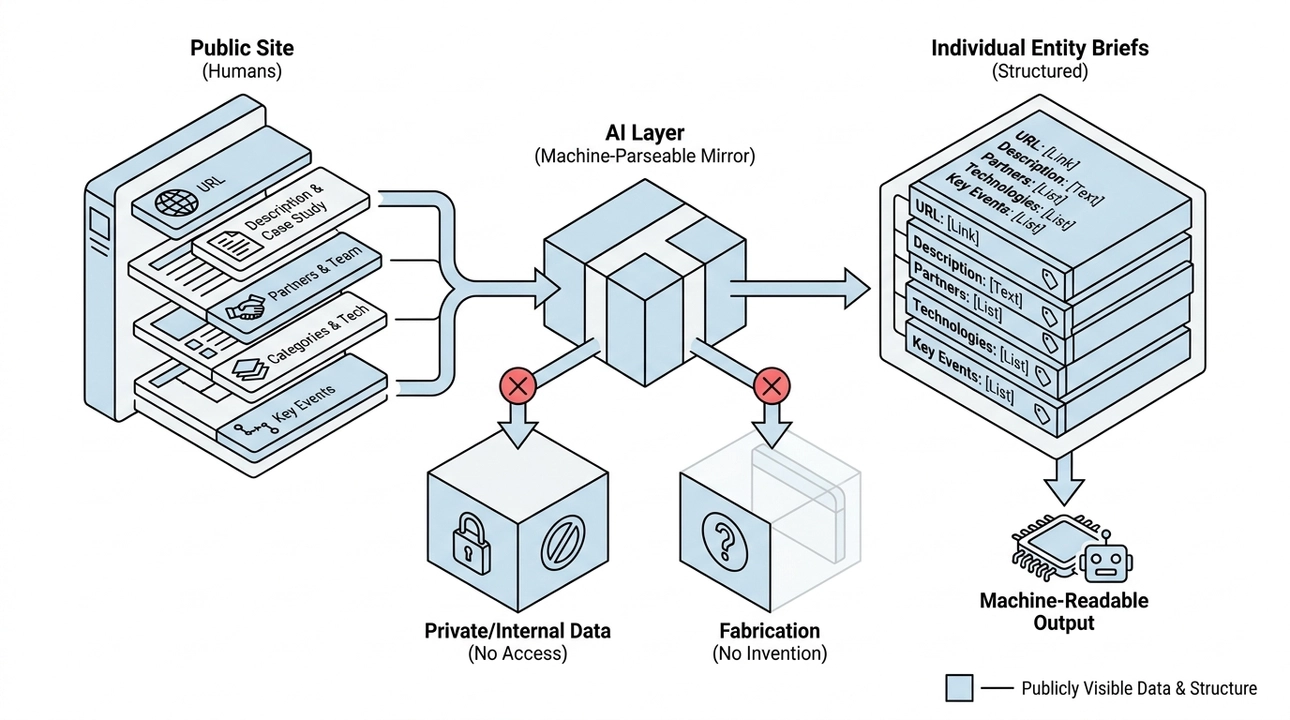
In other words, exactly what is already publicly visible on the page, just presented in a format that is easier for a machine to parse without ambiguity.
Two rules govern everything inside these files, and we treat them as hard constraints, not guidelines.
First: no private data. These files contain only what is already published and public. No internal notes, no administrative data, no information that lives behind any kind of access control. The AI layer is a clean mirror of the public site, nothing more.
Second: no fabrication. Every brief is assembled from the same real records and relationships that power the actual pages. If a field has no data, that block is simply omitted. We do not invent a description to fill a gap. We do not round up a partial fact to make the output look more complete. No data means no block, full stop.
These are the same principles we have carried through this entire content series: one source of truth for humans and for AI, and facts over approximations. The AI layer is just that principle applied at the infrastructure level.
Scaling This Across a Larger Site
For a portfolio site like Moonion's, a single index file and a set of entity briefs is enough. The structure is manageable and the content set is bounded.
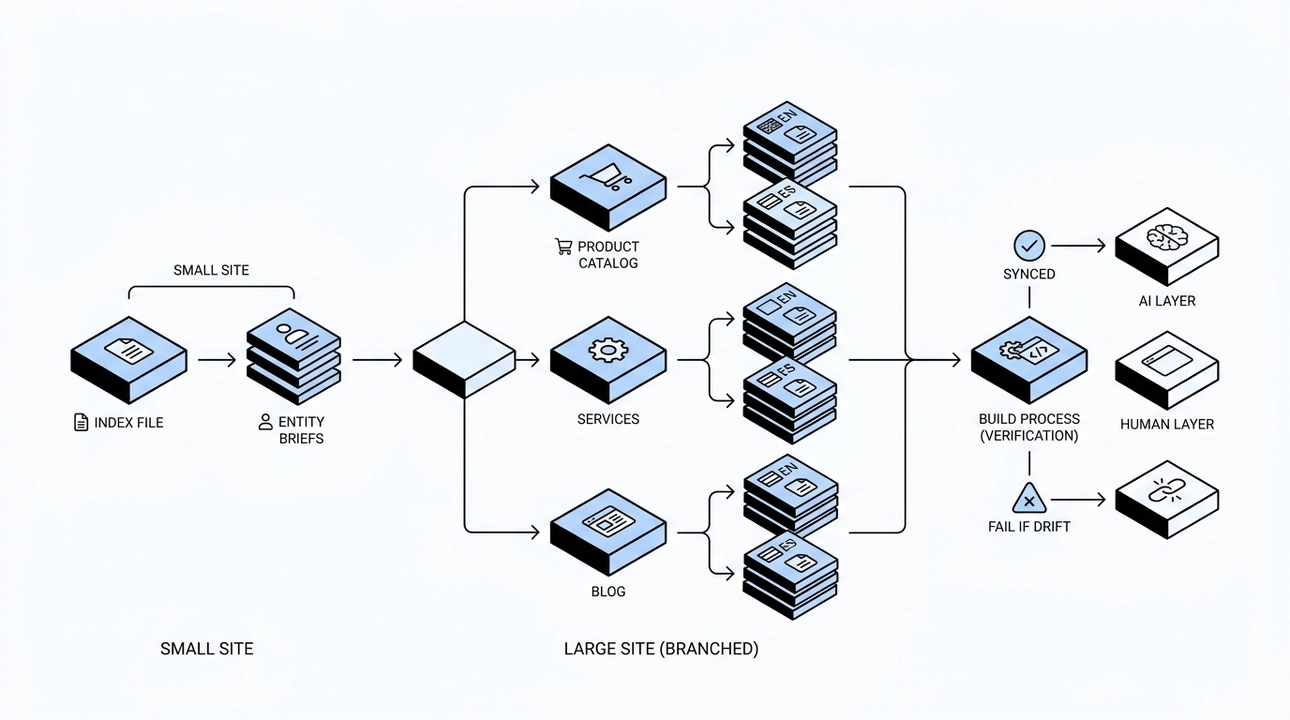
When the volume grows, the layer needs to branch. In a store we are currently building, the AI files are organized separately for the product catalog, for services, and for the blog. On top of that, each section has its own files per language. This means an AI system does not need to download the entire site to answer a question about one section. It can retrieve only the relevant part, which is faster, cleaner, and reduces the chance of cross-contamination between unrelated content areas.
The key design principle here is the same one that guides the rest of our architecture: structure the content so that the reader, whether human or machine, gets exactly what they need without having to infer or guess.
There is one more rule that emerged as the content volume grew: these files are verified automatically as part of the build process. The machine-readable version of the site cannot quietly drift away from the human-readable version. If the AI layer stops matching the actual content, the build fails. This is not optional discipline. It is enforced by the tooling, which means it actually holds.
What Happened When We Tested It
We did not ship this and hope for the best. We asked ChatGPT and Claude about Moonion directly, and we checked whether the answers matched reality.
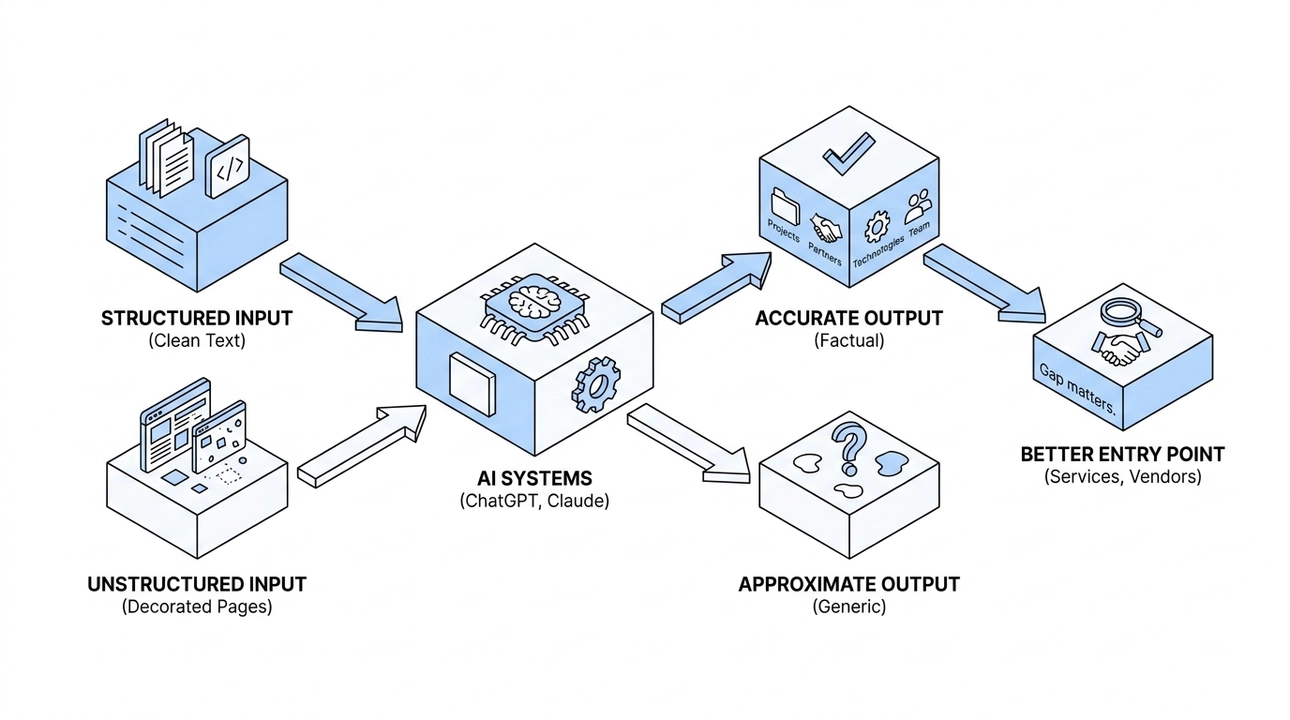
They did. Projects named correctly. Partners referenced accurately. Technologies and team details in the right place. All of this within a week of launching the AI layer, before the site had gone through a full indexing cycle.
I have run the same test on my own personal site, asking AI systems about me by name. The quality of the information I get back is noticeably better with properly structured files and clean text representation on the page than it was before. That is not surprising in retrospect, because the preconditions were there. But seeing it work is motivating in a specific way. It made me want to talk about it, because I know most companies are not doing this yet.
The AI systems genuinely find it easier to read clean text files than to parse decorated web pages. When you give them structured, factual input, they reproduce it accurately. When you leave it to chance, they approximate. That gap matters more every month as AI chat becomes a more common entry point for people looking for services, vendors, and collaborators.
Why This Is Worth Doing Now
This is not a large engineering project. For a portfolio or small business site, it is a few structured files and the discipline to keep them honest. The payoff is that you stop leaving your AI reputation to chance.
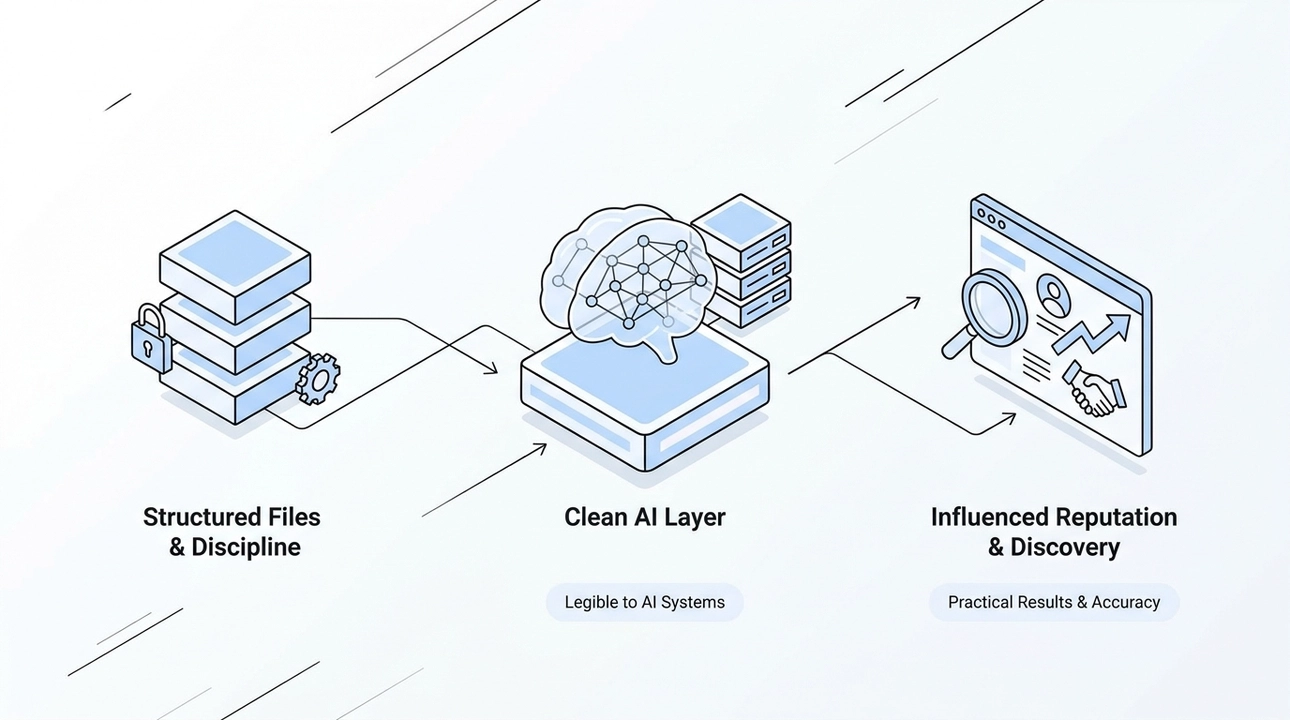
More people are discovering businesses through AI chat interfaces. That number is growing. When someone asks Claude which companies build blockchain-integrated platforms, or which teams specialize in high-load systems, the answer they get depends on what those AI systems have learned and how clearly that information was structured. You can influence that. You can give AI systems a clean, honest, accurate description of who you are and what you do, and you can verify that it stays accurate automatically.
That is what the AI layer is. Not a trick, not an optimization hack, not a speculative bet on some future technology. It is a straightforward practice: make your site legible to the systems that are already mediating discovery for your potential clients.
We built it because it was the right architectural decision. The results confirmed it was also a practical one.