9. How AI Writes Code Without Breaking Your Project

You ask an AI agent to fix a button. It fixes the button, then rewrites half the page while it's at it. This is the thing that scares most teams about letting AI touch production code, and honestly, the fear is legitimate. AI doesn't have the same instinct a senior developer has for "this is not my problem to solve right now." Without the right structure around it, it optimizes for completing the task as it understood it, not for protecting the work that already exists.
That fear doesn't go away by getting a smarter model. It goes away by building the process that contains the model. That's what an AI Ready Project does, and it's what we've built into how Moonion itself runs.
Two Modes, One Clear Boundary
The single most important structural decision we made was giving the AI agent two distinct operating modes, not a single set of rules with different permissions, but two genuinely separate contexts that don't bleed into each other.
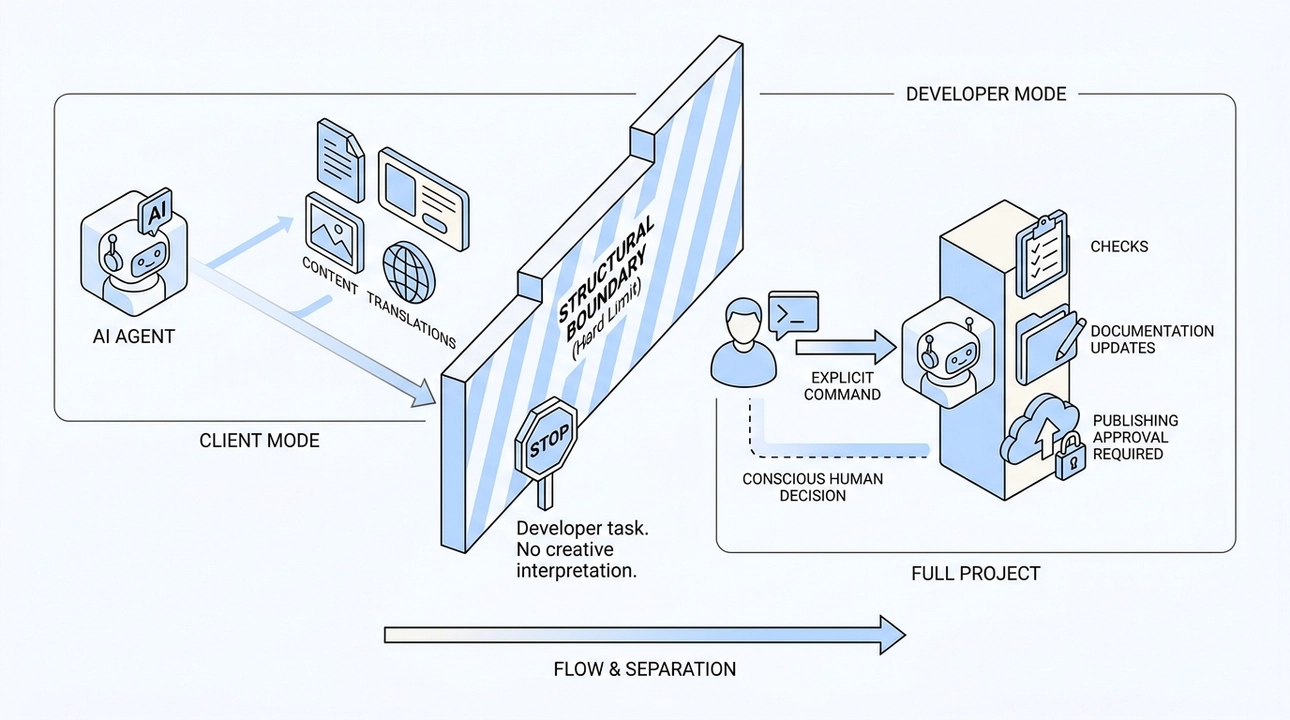
Client Mode is the default. In this mode, the agent can touch content: text, product cards, images, translations, page visibility. That's it. If a request actually requires changes to data structure, components, or publishing configuration, the agent doesn't attempt a workaround. It stops and says plainly: "This is a developer task." No judgment call, no creative interpretation of the scope. The boundary is structural.
Developer Mode is activated by an explicit command from a person. It opens the full project, but it comes with stricter requirements: a complete set of checks, mandatory documentation updates, and no publishing without explicit approval. The point is that switching modes is a conscious human decision, not something the model decides on its own because it seemed easier.
This distinction matters more than it might look. Even if a task is worded in a way where the fastest path would be a small code edit, the client-mode agent won't take it. The separation isn't a polite suggestion embedded in a prompt. It's a hard limit.
Checks That Actually Mean Something
The other load-bearing piece is automated quality checks, and these are two-tiered now.
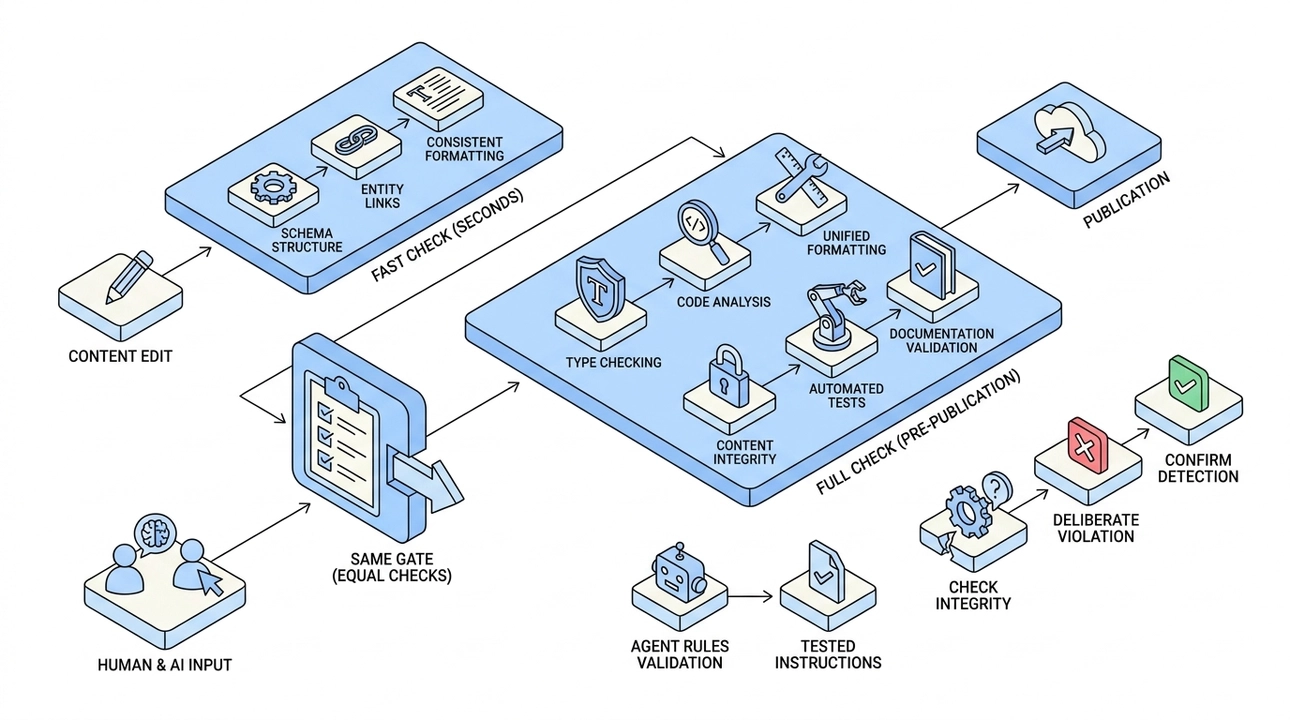
A fast check runs after every content edit. It takes seconds. It verifies that the schema structure is intact, that links between entities aren't broken, and that formatting is consistent. It's lightweight by design because it runs constantly.
The full check runs before any publication. It covers type checking, code analysis, unified formatting, documentation validation, content integrity, automated tests, and a complete site build. This is exactly what CI runs on the server. If anything fails, the change isn't considered done. There's no "we'll fix it after merge."
What matters here is that this check applies equally to AI-generated changes and human-written ones. There are no exceptions for the agent. Code that came from AI goes through the same gate as code a developer wrote. That's the only way "AI was involved" stops meaning "quality might be lower."
There's a detail in this that usually surprises people: the checks also validate the agent's own rules and skills. If an instruction references something that no longer exists in the project, or if a required section is missing from an agent skill, the build fails. The agent's operating instructions stop being a document that quietly goes stale. They become a tested, verified part of the project.
And one more thing that doesn't get talked about enough: the checks themselves can be broken. If a check always passes, it isn't proving anything. So every check has its own tests, and when we add a new rule, we deliberately trigger a violation first to confirm the check actually catches it. A green light has to be earned, not assumed.
Blocks, Not One Big Build
Risk in development often comes from having too much in flight at once. The project is somewhere in the middle of a large refactor, nothing is fully done, and it's hard to say what state anything is in. We solve this by cutting the project into blocks, where each block has explicit acceptance criteria and the next one doesn't start until the previous one is closed.

The sequence on Moonion's own site followed this logic. First the core: rules, skills, documentation, and the check system. Then the content model. Then the design system and accessibility. Then individual pages. Then machine-readable files for AI and the publication layer. Each step was small, reviewable, and finished before the next began.
The business value of this is straightforward. At any point, the project is in a verified state. There's no ambiguity about what's done and what isn't. You can look at the history of the Moonion site and see exactly this pattern: not a single commit called "AI built the site," but a sequence of specific, traceable steps. A separate skill for content, a separate pass for LLM summaries of projects and partners, metadata, sitemap timestamps, structured data, individual technical fixes. Each one small, each one checkable.
Memory Across Sessions
There's a characteristic of AI agents that's easy to overlook: every new session starts from scratch. The model doesn't carry memory of previous conversations by default. This means without something to orient it, an agent can spend time figuring out where the project is, make assumptions that conflict with earlier decisions, or repeat work that was already settled.

We addressed this with a dedicated memory system designed specifically for AI agents. It lives alongside the code and tracks what needs to be done, what depends on what, what's currently blocked and why, and the reasoning behind key decisions. When the agent starts a session, it reads this system first. It knows the current state of the project before it touches anything.
This is useful for humans too, but it was designed for the agent. For a product that supports AI agents and that will run for years, this kind of memory isn't overhead. It's how you avoid making the same mistake twice and how you keep a long-running project coherent across dozens of sessions with the same agent.
When Something Breaks
Even with all of this in place, things can break. That happens with human developers too. What matters is how the project recovers.
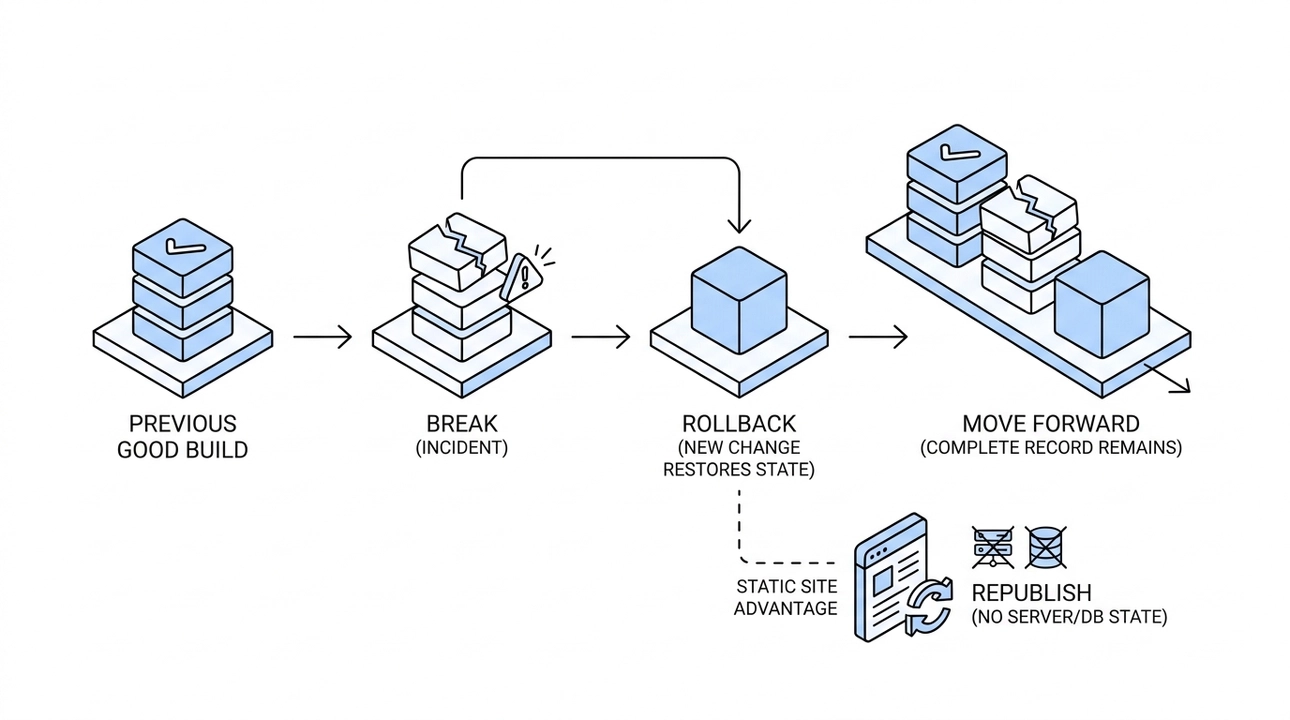
Our approach to rollback is to treat it as a new change that restores a previous state. Nothing in the history gets rewritten. You can see what existed before, what broke, and how it was fixed. The record is complete.
The fact that our site is statically generated makes this even more practical. Restoring a working version means republishing it. There's no server state to untangle, no database to reconcile. The previous good build goes back out, and the project moves forward from there.
What This Means in Practice
When AI is embedded inside an engineering process rather than dropped on top of one, the outcomes are different. Small, bounded changes instead of large opaque rewrites. Checks that apply to everyone, including the agent. Blocks that close cleanly before the next one opens. Memory that keeps the agent oriented. Rollback that preserves the record.
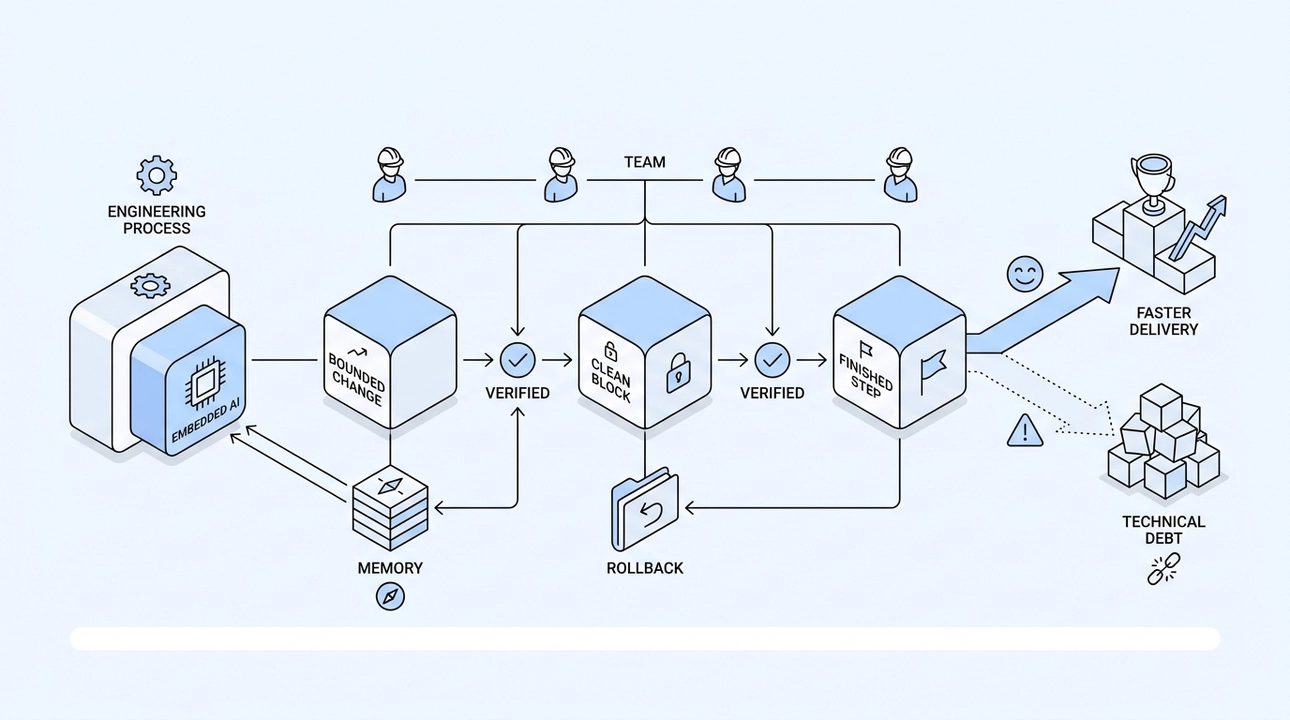
The Moonion site is the clearest example we have of this working. It wasn't built in one AI-driven session. It was built step by step, with every step checked and every block verified before moving on.
The result is a product where AI participation means faster delivery, not accumulated technical debt. That's the actual difference between an AI agent that accelerates a team and one that quietly creates problems for the next developer to inherit.